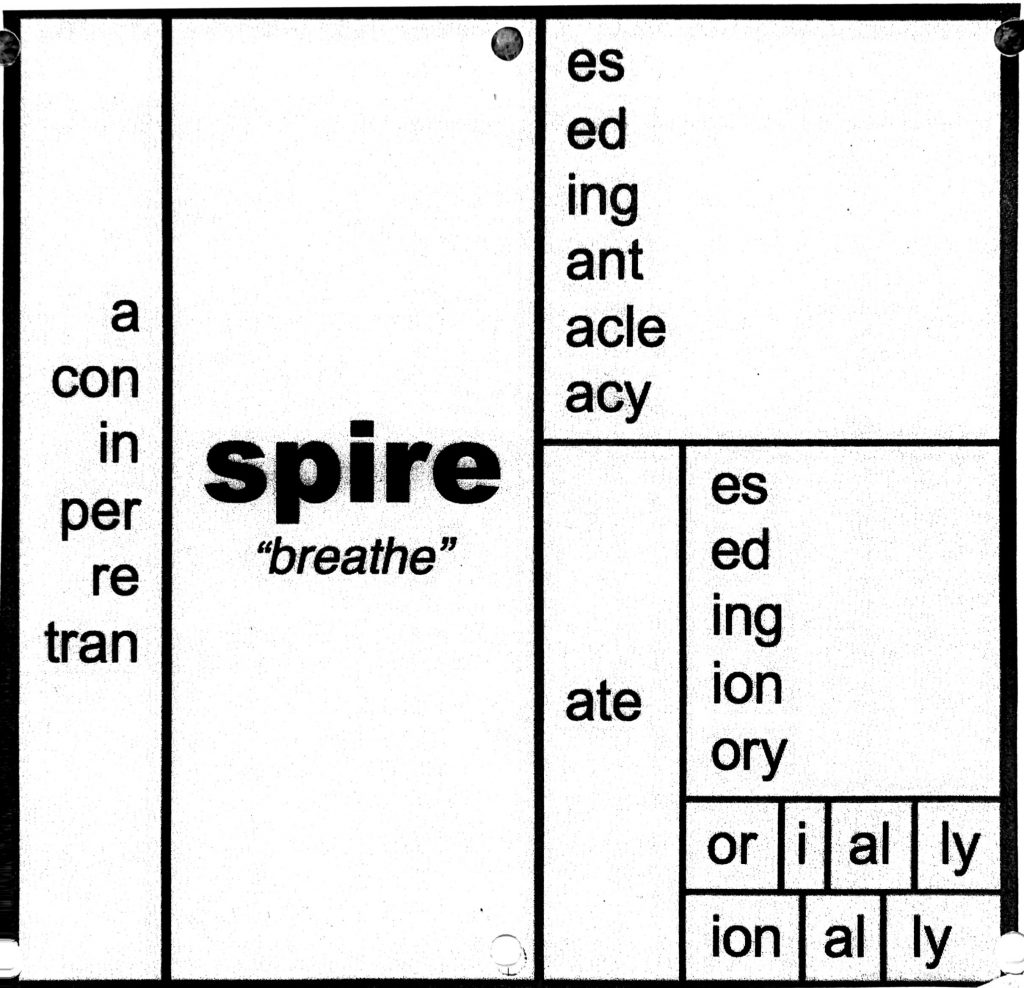
The most beautiful breeze breathes through my new house as I write. The emptiness of the house fills with cool air, and exhales, new again. Whenever I imagine breathing, I think of the <spir(e)> word family.
“Most people’s lives are like a square. Mine is a dodecahedron.” My new eighth grader smiles at me. We’re just getting to know each other and she throws this at me. How brilliant. This is our entry point. This is the beginning of our study.
Summer is ending. The nights are growing cool. Apple picking and warm cinnamon desserts are on our minds. A season full of beautiful colors and words like <autumn>, with an <n> waiting to shine in <autumnal>. The months of September, October and November have denotations of “seven”, “eight” and “nine”, even though they are the 9th, 10th and 11th months of the year. Stories ready to be raked into a tantalizing, jump-worthy pile.
Mistakes. So often in our teaching we have created a culture afraid of forming hypotheses. ‘Correctness Mongers’, my teacher in France calls us. Correct → cor + rect, “to bring in accordance with a standard or original, straight” (Etymonline). Why would I want anyone’s thinking, let alone my students’, to constantly align with my own?
“I have always struggled with and ”, I admit to my new student, a soft spoken fourteen year-old boy. He looks down still smiling and attempts to help his fellow dyslexic. “Well, the one with the is like something that happens to you. And the other is like what you do to someone…. I think.” He’s explaining parts of speech without realizing it.
My new fourth grader and I are meeting for the second time to study. She is new to me, but not new to difficulty. Not new to the constant attempt of making sense of something (the writing system) that often feels nonsensical. “Rules” that feel empty. Vacuous.
You see, we live in a literate world, and if you don’t play the game, if you aren’t able to put together the pieces of instruction that actually don’t make sense, and if you aren’t able to “just memorize”, you’re sunk.